
Every batch VGM BIO releases ships with analytical documentation. If you have never had to read one closely, here is what the numbers on a Certificate of Analysis actually describe — and what they do not.
Identity: mass spectrometry
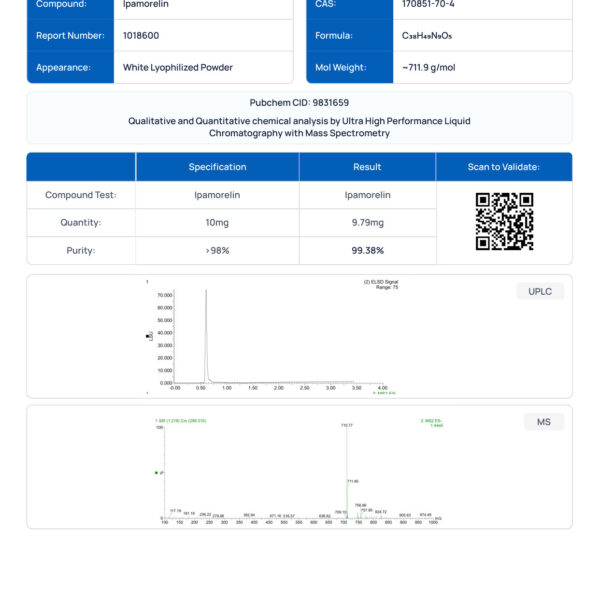
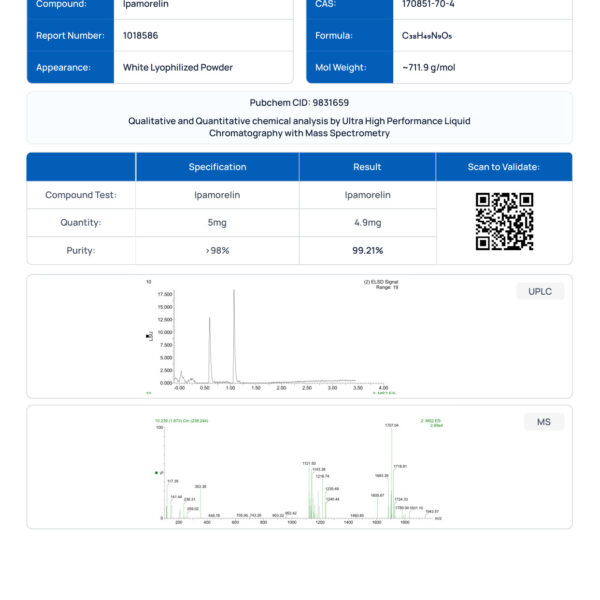
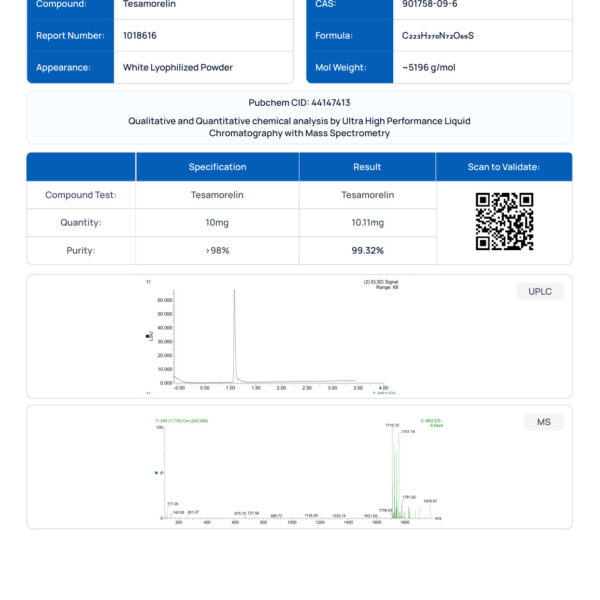
The first question a certificate answers is whether the material is the sequence it claims to be. Mass spectrometry measures the molecular weight of the compound and compares it against the theoretical weight calculated from the sequence. A match within a narrow tolerance confirms identity; a deviation suggests an incorrect sequence, incomplete synthesis, or modification.
Purity: HPLC
High-performance liquid chromatography separates the sample into its components and plots them as peaks. The target peptide produces a dominant peak; anything else — truncated sequences, deletion products, residual reagents — appears as smaller peaks alongside it.
Purity is expressed as the area of the main peak as a percentage of total peak area. A result of 99%+ means the target sequence accounts for at least 99% of the detected material. It is a relative measurement, not an absolute one: it describes the proportion of what the detector sees, which is why the chromatogram matters as much as the headline figure.
What a certificate does not tell you
A CoA describes a specific batch at the point of testing. It says nothing about how the material has been stored or handled since, which is why storage conditions matter as much as the original release data — see our note on storage and stability.
It also carries no therapeutic meaning. Analytical purity is a statement about chemistry, not about safety or suitability for any application beyond laboratory research.
Checking ours
Purity certificates for the current batch are published in the certificate library. Batch-specific documentation for an individual order is available on request.
For research use only. Not for human or veterinary use.