Everything a peptide does — how it folds, how stable it is, how it degrades — traces back to one repeated chemical link: the peptide bond.
The bond itself
A peptide bond forms when the carboxyl group of one amino acid reacts with the amino group of the next, releasing a molecule of water. This is a condensation reaction, and the reverse — hydrolysis — is exactly what happens when a peptide degrades in solution.
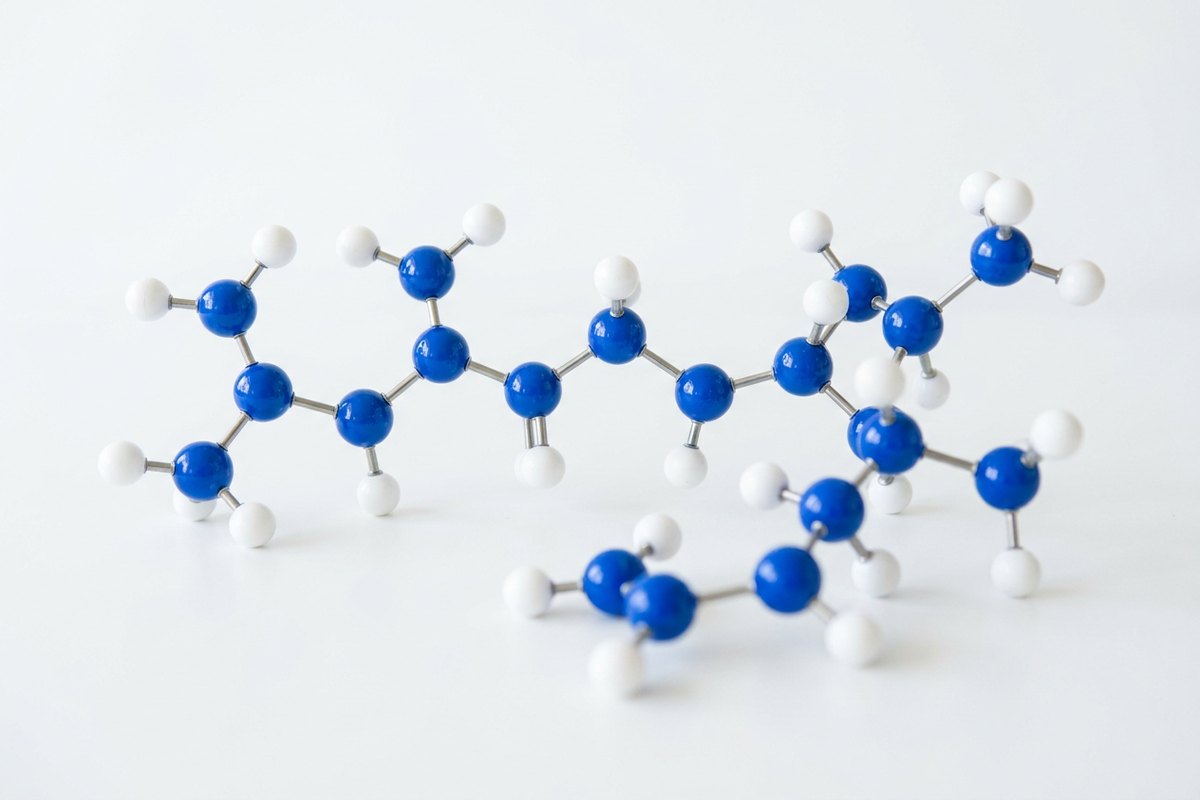
The resulting C–N linkage has partial double-bond character. That single fact explains a surprising amount: the bond is planar and rigid, rotation around it is restricted, and the chain can only flex at the neighbouring bonds. Peptides are therefore not free-floating strings; they are semi-rigid structures with a limited set of favourable conformations.
From chain to structure
Chain length is what separates the terminology. Short chains are peptides; longer chains fold into proteins. BPC-157, for instance, is a 15–amino acid pentadecapeptide, while GHK-Cu is a tripeptide of just three residues bound to copper. Both are peptides, but their size drives completely different behaviour in solution and in storage.
Why this matters at the bench
Because hydrolysis is the reverse of the reaction that formed the molecule, water exposure is the primary stability risk for any peptide — the reason material ships lyophilised and has a much shorter life once reconstituted. Sequence matters too: residues such as methionine and cysteine introduce oxidation-sensitive sites that the backbone alone would not have.
Understanding the bond does not change your protocol, but it does explain why the handling rules exist.
For research use only. Not for human or veterinary use.